
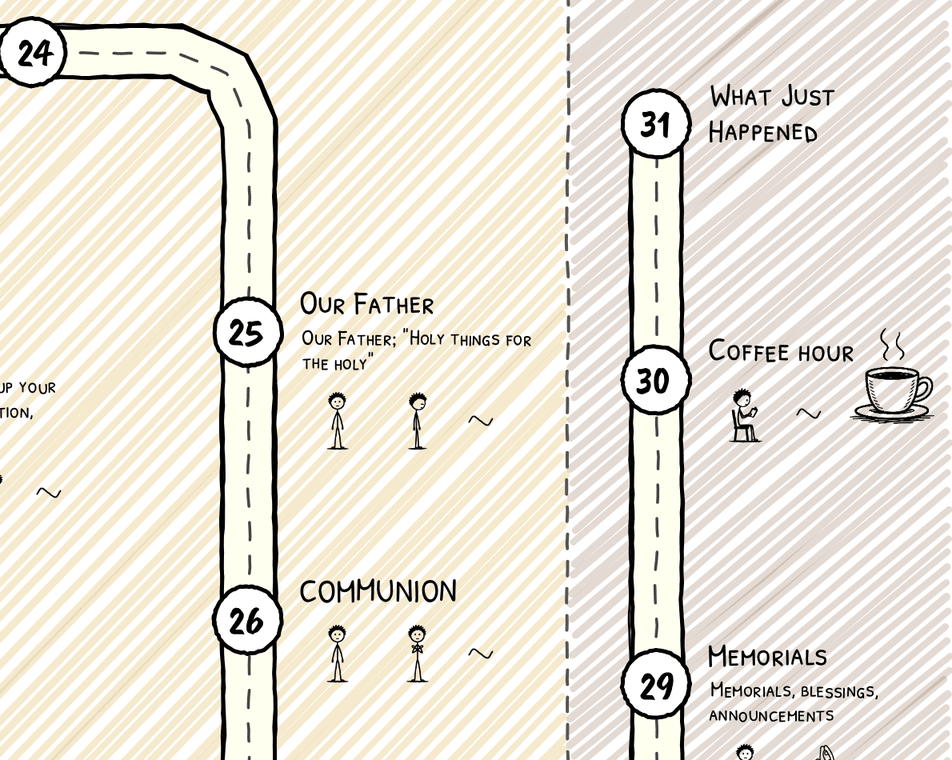


What you'll notice
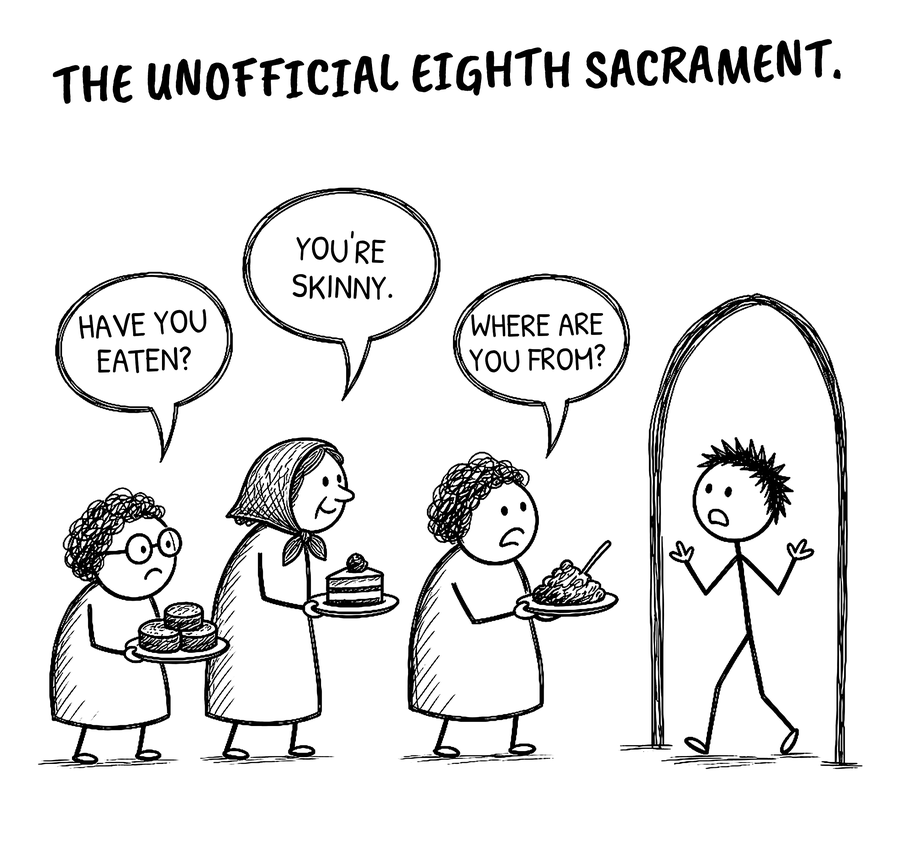
Everybody goes downstairs, or next door, or out under a tent, and eats. The spread runs from a pot of coffee and a box of donuts to a hot lunch with three kinds of pastry and a man at a grill, depending on the parish, the Sunday, and whether it's a fast. People who stood in near-silence all morning are now loud. Children are running. The priest is at a table with his cape off and a plate in front of him, and a line of people waiting to ask him one thing. Someone you've never met hands you a cup and says, kindly, "Are you visiting?"
Or nobody does, and you stand by the wall holding a napkin, wondering whether this part is over too.
What it's called
Coffee hour. Some parishes say fellowship hour, or the social, or just the hall. Russian parishes may call it trapeza (the monastery word for the refectory meal), which is a grand name for coffee and cheese and also exactly right. There's no liturgical name for it because it isn't in the books.
What's actually happening
The Church has eaten together since the first weeks after Pentecost: "breaking bread from house to house, they ate their food with gladness and simplicity of heart" (Acts 2:46). Saint Jude mentions the "love feasts" (Jude 12), agape in Greek, and around 197 Tertullian explained the name to pagan readers: "Our feast explains itself by its name," and "with the good things of the feast we benefit the needy."1 Saint Paul had to scold the Corinthians for eating their own suppers without waiting for the poor (1 Corinthians 11:20–22), and the councils eventually threw the potluck out of the nave altogether: "It is not permitted to hold love feasts, as they are called, in the Lord's Houses, or Churches."2 So coffee hour is a hall custom, held exactly where the canons sent the food: next door. Parishes that trace it to the love feast are arguing family resemblance, and the resemblance is real. The Church that just fed you Christ now wants to feed you lunch—in the other room.
Why it matters
The honest reason is that the hall is where a visitor finds out whether the parish is a church or a museum. The Liturgy was beautiful whether anyone spoke to you or not. The hall is where someone either does or doesn't. At the heart of the Anaphora the priest offers the gifts "in behalf of all, and for all,"3 with David's words behind him, "of Your own we have given You" (1 Chronicles 29:14 (1 Paralipomenon 29:14 in the Septuagint)): none of it was ours to begin with. A parish where visitors are ignored has forgotten that the Liturgy, the Church, and the coffee hour aren't theirs either. The coffee hour is in the Anaphora. It's the last line of "in behalf of all."
The second reason the Orthodox will admit after the second cup: nobody has ever been argued into the Church, but a good many people have been fed into it, one Sunday at a time, by a woman with a tray who remembered their name.
The bishops have noticed the hall. The Greek Archdiocese's outreach department asks greeters for "a sincere smile and a handshake" and warns that "prompt follow-up with visitors is critical."4 The Assembly of Canonical Orthodox Bishops' 2017 national study gave a whole chapter to good practices for welcoming first-time visitors.5 An OCA piece is blunter: a parish with no plan for greeting visitors has "the worst program possible," and the greeting is the parishioners' job.6
Where it came from
The coffee hour as you'll meet it grew up in American parishes, where the parish was also the community and the hall was where the community lived: Greek school, the ladies' society cooking, the choir rehearsing, the Arabic the kids were losing. If you want to know what a parish is like, the hall will tell you faster than the church.
Practice differs from parish to parish: whether there's food at all; potluck, rotating families, a parish society, or a caterer; free or a donation jar. On fast days the spread will be fasting food and still too much. Ask whoever's holding the coffee pot.
What you do
If you're Orthodox: find the visitor. You know who it is: the one by the wall with the napkin. Bring a cup, ask where they're from, and don't ask whether they're going to convert. Introduce them to one other person and then let them go. Bring food on your Sunday; clean up on someone else's.
If you're visiting: you're invited. Don't slip out after the cross, however tempting the parking lot. Walk in, get a cup, and stand somewhere central. Nobody expects a donation; if there's a jar, it's for members. When someone asks "Are you visiting?", they mean it kindly, and "yes" is the whole answer required. If nobody's spoken to you in five minutes, go to the priest's table and introduce yourself; he'll hand you to the right person. Eat the food. Ask the question you've been holding all morning; this is where it gets answered. And if you'd rather skip the coffee, skip it. Nobody's counting cups.
Field Note: Orthodox hunger. The Orthodox who received Communion have eaten nothing since the night before, and it's past eleven. The speed with which a Greek parish converts from the Cherubic Hymn to the baklava has nothing to do with greed: the body is asking for what the soul just got.
Go deeper
- Acts 2:42–47; 1 Corinthians 11:17–34; Jude 12.
- Tertullian, Apology 39 (ANF 3).
- Alexei Krindatch, Go and Make Disciples: Evangelization and Outreach in US Orthodox Parishes (Assembly of Canonical Orthodox Bishops of the USA, 2017).
Notes
-
Tertullian, Apology 39 (ANF 3). ↩
-
Council of Laodicea, canon 28, renewed by Trullo, canon 74 (NPNF2 14). ↩
-
Hapgood, Service Book, p. 105. ↩
-
GOA Department of Stewardship, Outreach & Evangelism, Outreach & Evangelism: Practical Steps. ↩
-
Krindatch, Go and Make Disciples. ↩
-
Prokurat, "I'm New Here," OCA. ↩