
What you'll notice
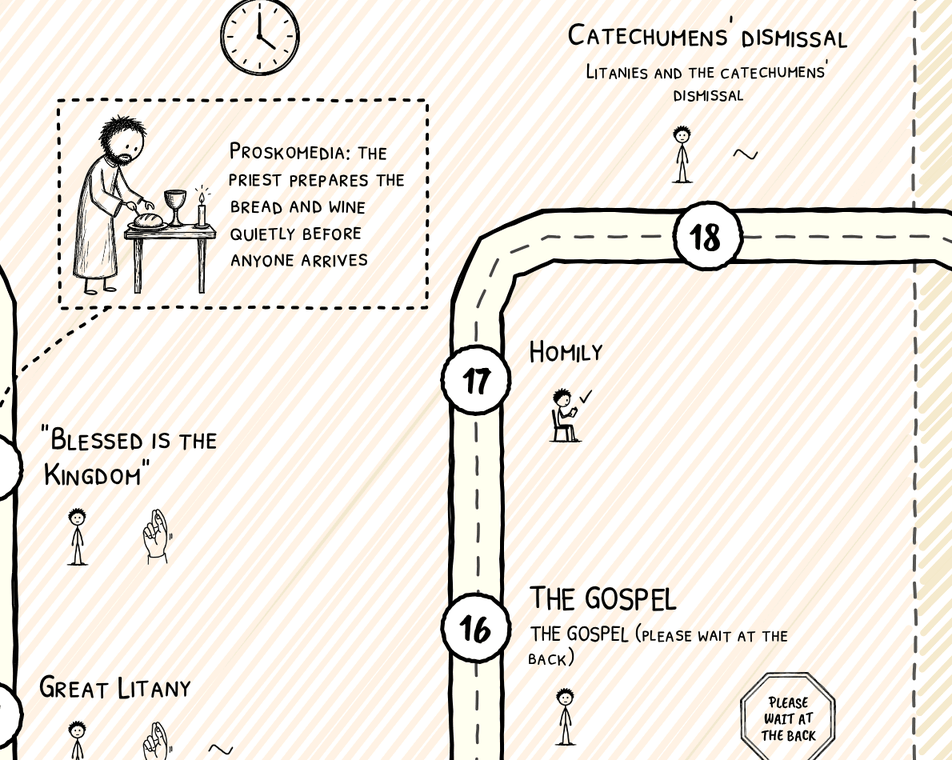
The Gospel book goes back in, and the priest comes out. He stands at the center, or climbs into the pulpit, and talks, in ordinary English, about what was just read. People sit if there's anything to sit on. It lasts ten to twenty minutes. There's no altar call, no closing hymn, no second offering; when he's done he goes back through the doors and the deacon starts singing again as if nothing happened.
In some parishes the homily comes later, before Communion or at the very end of the service. Gogol explains the drift: the sermon was once an explanation of the day's Gospel, and once it stopped being that, it wandered to the end.1 Hapgood's rubric allows either place,2 but the oldest place is right after the readings. So if your parish preaches at the end, that's a later custom, not a mistake. The content is the same; the clock is different.
What it's called
The homily (Greek omilia, which originally meant a conversation; Slavonic propoved'; Arabic al-ʿiẓa, "the exhortation"). "Sermon" is fine too; nobody will correct you. The Orthodox tend to say homily because the word implies talking with people rather than at them.
What's actually happening
The Gospel of Jesus Christ must be preached, and the logical place to do it is right after it's been read. That's the whole theory. The priest's job in this quarter hour is to take the passage everyone just heard and connect it to the people standing in front of him, this week, in this town.
It's shorter than a Protestant sermon and more tied to the text than most. That's not because Orthodox priests have less to say. The Liturgy itself is the main teaching, every hymn and gesture of it, and the homily is one voice inside a much longer conversation. Saint Justin Martyr described the same shape in the second century: when the reader finishes, "the president verbally instructs, and exhorts to the imitation of these good things."3 Reading, then exhortation. The order hasn't changed in eighteen centuries.
Why it matters
"How shall they hear without a preacher?" (Romans 10:14). The Orthodox believe in preaching; they just don't believe it's the point of Sunday. The point of Sunday is the chalice, and the homily is on the way there.
That said, the Church produced the greatest preacher in Christian history. Saint John Chrysostom, whose Liturgy you're attending, was called "golden-mouth" by people who had heard him. The ancient Church sometimes heard several sermons in one service, from several clergy.4 Today you get one, and it's usually about the Gospel, because the Gospel is right there and the priest, like the rest of us, has just stood up for it.
Where it came from
The synagogue again, and Nazareth again. Jesus read Isaiah, closed the book, sat down, and said, "Today this Scripture is fulfilled in your hearing" (Luke 4:21), which is the first Christian homily and still the shortest. The pattern is older than Nazareth: when Ezra read the Law to Jerusalem, the Levites "gave the sense, and helped them to understand the reading" (Nehemiah 8:8 (2 Esdras 18:8 in the Septuagint)). The apostles preached in synagogues until they were thrown out (Acts 13:14–16), and the Christian assembly kept the pattern: Scripture, then someone explaining it.
The great age of Orthodox preaching was the fourth and fifth centuries, Chrysostom in Antioch and Constantinople, Basil and the two Gregories in Cappadocia, and thousands of their homilies survive, which is how we know what ordinary Christians were being told. For long stretches afterward the homily thinned out or disappeared, replaced in some places by a read sermon from a book. Getcha insists it belongs where it started, as a part of the Liturgy and not an intermission in it.5
The pulpit, where there is one, is a Western-looking addition in some Greek churches. Its ancestor is the ambo, the raised platform in the middle of the old basilicas, from which Saint John Chrysostom preached; the solea (the raised walkway in front of the icon screen) began as the walkway that joined the ambo to the altar. The priest standing at the center of the solea to preach is standing on the ambo's ghost.
What you do
If you're Orthodox: sit if you can, listen, and don't leave. If your priest preaches at the end instead, don't leave then either. Nobody is grading you on note-taking, but a homily is the one place the priest tells you what he thinks you need to hear, and that's worth ten minutes.
If you're visiting: relax. This is the part of the service built for you: one voice, plain language, no cues. If the homily is good, you'll learn something about the reading. If it's not, you'll learn something about the priest, which is also useful. Either way, when he goes back through the doors, stand up, because the service is about to pick up speed.
Field Note: no altar call. Visitors from evangelical churches sometimes wait for the invitation at the end of the homily and are puzzled when none comes. There's no altar call in an Orthodox church because the altar is about to call everyone, in about twenty minutes, with bread and wine. The invitation is the Liturgy. The homily just reminds you it's coming.
Go deeper
- Luke 4:16–30, and Nehemiah 8:1–12 (2 Esdras 18:1–12 in the Septuagint).
- Saint John Chrysostom, Homilies on the Gospel of Matthew (NPNF1 10), any one of them, to hear what a homily can be.
- Romans 10:8–17.