
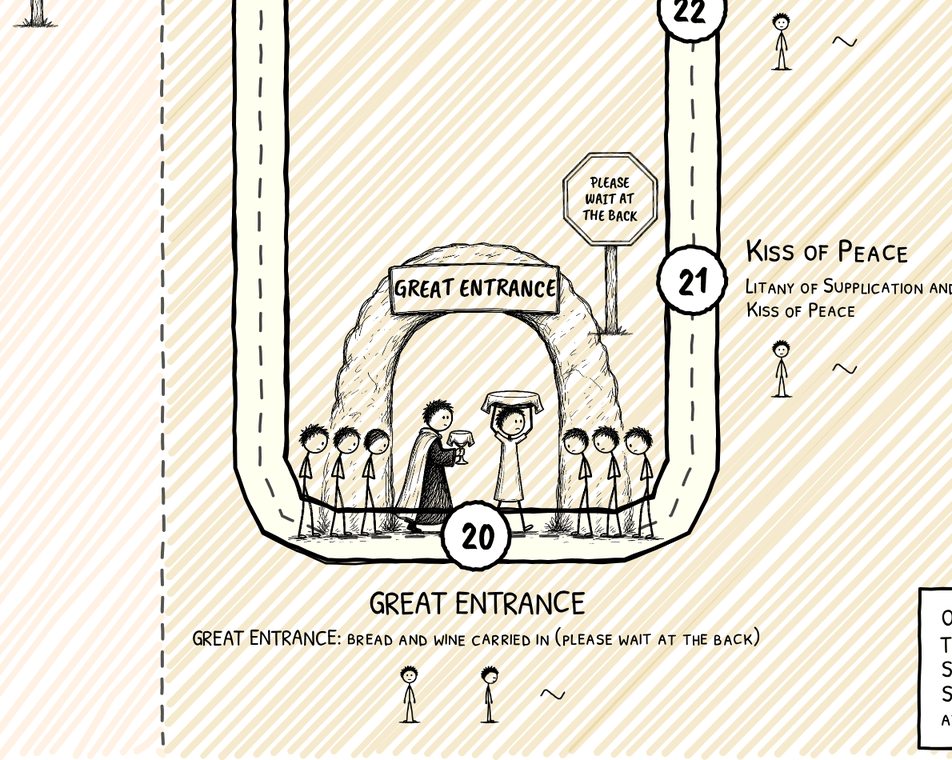

What you'll notice
The gifts are on the altar, and the deacon is back out front for another round of petitions. But listen to the choir. All morning they've been answering "Lord, have mercy." Now, partway through, the answer changes to "Grant it, O Lord," over and over, and the petitions have changed too: they're about how you'll live today and how you'll die.1
Behind the screen, while the deacon leads, the priest is praying quietly at the altar. You won't hear him. The litany ends the way most litanies do, by handing everything over: "let us commend ourselves, and each other, and all our life unto Christ our God," and the choir answers, "To thee, O Lord."2 Then the priest says, "Peace be with you all," and the room turns toward the next stop.
What it's called
The Litany of Supplication, also the Completed Litany or, in Greek, the Plerotika (Πληρωτικά), because it "fills out" the prayers; Slavonic prositel'naya ekteniya. Under the litany, quietly, the priest says the Prayer of Offering, asking God to "accept also the prayer of us sinners, and bear it to thy holy Altar."3
What's actually happening
The Church is asking for a good day and a good death, in that order.
The petitions run: for "a day all-perfect, holy, peaceful and sinless"; an angel of peace to guard us; forgiveness; "all things which are profitable to our souls and bodies, and peace to the world"; the rest of our life "in peace and penitence"; and "a Christian ending to our life, painless, blameless, peaceful; and a good defence before the dread Judgment Seat of Christ."4 Time, peace, repentance. The Wisdom of Solomon says God teaches His people that He gives repentance for sins, and that is the whole shape of the litany (Wisdom 12:19).
That last petition is the one people remember. It's the one request in the Liturgy that everyone eventually gets an answer to.
The Church thinks these requests are worth making twice. The same petitions come back, nearly word for word, just before the Lord's Prayer.5
Why it matters
While the deacon asks for the day, the priest asks for the offering. The Prayer of Offering under the litany keeps returning to the word sacrifice. It addresses God as the one "who acceptest the sacrifice of praise from those who call upon thee with their whole heart," and asks Him to "enable us to offer unto thee gifts and spiritual sacrifices for our sins and for the errors which thy people have committed through ignorance."6 Our bread, our wine, our morning. Then He takes it from there.
The prayer doesn't stop at the gifts. It asks that "the good spirit of thy grace may rest upon us, and upon these Holy Gifts, now offered up unto thee, and upon all thy people."7 The people standing in the nave are part of what's being offered.
And the petition about the Judgment Seat is honest in a way people don't always expect from church. It doesn't ask to skip the judgment. It asks for "a good defence" when we get there. That's repentance with a deadline, asked for calmly, every Sunday.
Where it came from
The litany itself is a later addition to the rite.8 Its petitions weren't written for the Liturgy alone. At Vespers the deacon opens the same litany with "Let us complete our evening prayer unto the Lord," and the first request is for "an evening all-perfect, holy, peaceful and sinless."9 The Church kept the words and changed the hour.
What you do
If you're Orthodox: answer "Grant it, O Lord" and mean the one about your death; it's good for you.
If you're visiting: nothing is asked of you. If you'd like to join in, the response is four words, and the choir will sing it enough times for you to catch it. When the priest says "Peace be with you all" and the next call goes out, that's the Kiss of Peace.
Field Note: two answers. "Lord, have mercy" is what you say when you're asking for help. "Grant it, O Lord" is what you say when you're asking for a thing. The Church switches responses mid-litany, and once you hear it you can't unhear it.
Field Note: whether the priest is a good man. The Prayer of Offering is said by a man who, in the same breath, calls himself a sinner. The Church settled a long time ago that the sacrament doesn't depend on the priest's worthiness; it depends on God. That's a relief for the priest, and for you.
Go deeper
- Wisdom of Solomon 12:19.
- Hapgood, Service Book, pp. 98 to 99, the Prayer of Offering included.
- Getcha, The Euchologion Unveiled, p. 51.
Notes
-
Hapgood, Service Book, pp. 98 to 99. ↩
-
Hapgood, Service Book, p. 99. ↩
-
Hapgood, Service Book, p. 98. ↩
-
Hapgood, Service Book, pp. 98 to 99. ↩
-
Hapgood, Service Book, pp. 111 to 112. ↩
-
Hapgood, Service Book, p. 98. ↩
-
Hapgood, Service Book, p. 98. ↩
-
Getcha, The Euchologion Unveiled, p. 51. ↩
-
Hapgood, Service Book, p. 10 (Great Vespers, in the All-Night Vigil). ↩