
What you'll notice
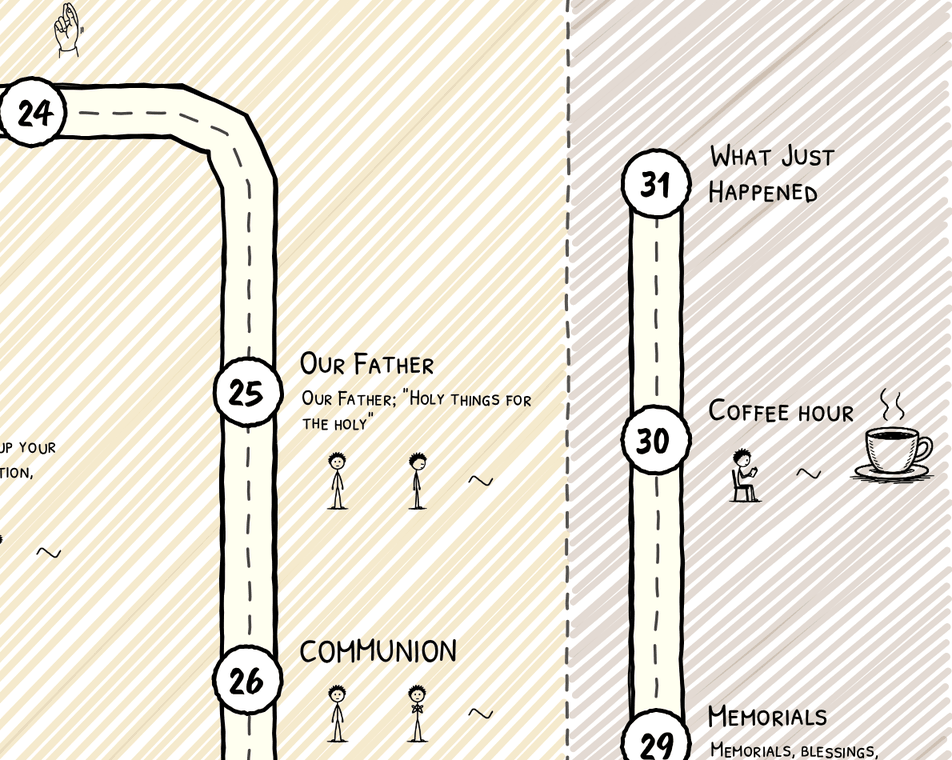
It's one o'clock. You're back at the car with a napkin of blessed bread on the passenger seat, your coat smelling of incense, and the odd sense that you were somewhere for three hours (Orthros, or Matins, then the Liturgy, then coffee) and can't say exactly where. A few things are clear: the gold, the baby who received, the woman with the coffee, the moment the doors opened and everyone stood. The rest is chanting and "Lord, have mercy."
What it's called
Orthodox writers have a phrase for the part that starts in the parking lot, "the liturgy after the Liturgy," meaning the service didn't end at the doors and what you were handed in there you're now to carry out here.
What's actually happening
The Liturgy opened with "Blessed is the Kingdom" and it closed by sending you out of the building. Everything in between was the Church asking for that Kingdom and being given a taste of it: the Gospel carried in, the bread and wine carried in, the bread and wine carried out changed, and the people fed or blessed and dismissed. Archimandrite Vasileios says the man who comes down from the mountain of the Liturgy comes down a witness to the Kingdom.1 Gogol closes his little commentary with the clergy leaving the altar in joy, as from a feast.2
Why it matters
That fog is normal. The two disciples walking to Emmaus didn't recognize him either, until he broke the bread and vanished, and only then did they say, "Did not our heart burn within us?" (Luke 24:30–35). Most people's first Liturgy is the walk, not the recognition. The recognition comes later, in the car.
Where it came from
The Church has her own answer to "what now," and it's printed. Hapgood gives the thanksgiving prayers after Communion, which her rubric has the priest say once the Holy Door is closed,3 and they're mostly about not wasting what you were given.
What you do
If you're Orthodox: say the thanksgiving prayers, in the car if you have to. Keep the fast you were given and break it with gladness. Come back next week, and the week after, until the walk is so familiar you stop noticing it, and then read this guide again to start noticing.
If you're visiting: you've done the hard part, which was walking in. If something burned, pay attention to it; the Emmaus disciples walked seven miles back to Jerusalem in the dark on the strength of a feeling. You don't have to. Come back next Sunday, or read a few more pages first. If nothing burned, that's allowed too. The Church prayed for you this morning anyway, when it remembered "this congregation here present" and offered the gifts "in behalf of all, and for all."4 That was you.
This walk raised more questions than it answered, on purpose. Why do the Orthodox kiss everything? Why is Pascha on a different Sunday? What do they believe about Mary and the saints, the Bible, the Pope, the end of the world, bacon? How do converts get in? What happened in 1054, and did it? The rest of the guide takes those one at a time. Pick one up anywhere. The glossary is there for when you've forgotten what a prokeimenon (the psalm verse sung before the Epistle) is, which you will.
Field Note: Orthodoxy by the yard. Everything in this walk is in the Liturgy itself, and almost none of it was explained to you there. The Church teaches by repetition; it assumes you'll be back, and that over twenty years the Gospel book and the doors and the bread will teach you what no class could. This guide is the brochure the Church was too dignified to print. Use it, and then put it down.
Go deeper
- Luke 24:13–35.
- Hapgood, Service Book, Prayers of Thanksgiving after Communion, pp. 123–126.
- Alexander Schmemann, Introduction to Liturgical Theology.
- Archimandrite Vasileios, Hymn of Entry, p. 79.